



The Financial Crimes Enforcement Network (“FinCEN”) is re-issuing frequently asked questions (FAQs) regarding customer due diligence requirements for covered financial institutions. These FAQs were separately published on July 19, 2016, April 3, 2018, and August 3, 2020, to assist covered financial institutions in understanding the scope of the final rule Customer Due Diligence Requirements for Financial Institutions, published on May 11, 2016, and amended on September 29, 2017 (“CDD Rule” or “the Rule”). The purpose of re-issuing the FAQs is to consolidate the three sets of FAQs into one document and update certain FAQs to align with the exceptive relief order FinCEN issued on February 13, 2026 (FIN-2026-R001) (“Account Opening Exceptive Relief Order”).
For further information regarding customer due diligence requirements, including the CDD Rule, please see FinCEN’s CDD webpage.
Read the PDF version of the FAQs
A. General Questions
A. 1. Why did FinCEN issue the CDD Rule?
A. 2. Does the CDD Rule apply to all financial institutions?
A. 3. What was the effective date of the CDD Rule?
A. 4. When must covered financial institutions implement the final rule?
A. 5. Which financial institutions are covered under the CDD Rule?
B. Beneficial Ownership Information Collection under the CDD Rule
B. 1.b. What does the Account Opening Exceptive Relief Order authorize?
B. 5. Who is a "beneficial owner" under the CDD Rule?
C. Account
C. 1. How is “account” defined in the CDD Rule?
C. 4. Are there any type of accounts that are not covered by the CDD Rule?
D. Certification Form
E. Legal Entity Customer
E. 1.Who is a “legal entity customer”?
E. 3. Are trusts included in the definition of legal entity customer?
E. 13. What kind of businesses and equipment are covered under the equipment finance exemption?
F. Nature and Purpose/Customer Risk Profile/Ongoing Monitoring
F. 4. Is it a requirement under the CDD Rule that covered financial institutions:
- Collect information about expected activity on all customers at account opening, or on an ongoing or periodic basis;
- Conduct media searches or screening for news articles on all customers or other related parties, such as beneficial owners, either at account opening, or on an ongoing or periodic basis;
- Collect information that identifies underlying transacting parties when a financial institution offers correspondent banking or omnibus accounts to other financial institutions (i.e., a customer's customer)?
F. 5. Is it a requirement under the CDD Rule that covered financial institutions:
- Use a specific method or categorization to risk rate customers; or
- Automatically categorize as "high risk" products and customer types that are identified in government publications as having characteristics that could potentially expose the institution to risks?
G. Other
A. General Questions
A. 1. Why did FinCEN issue the CDD Rule?
FinCEN issued the CDD Rule to amend existing Bank Secrecy Act (BSA) regulations in order to clarify and strengthen customer due diligence (CDD) requirements for certain financial institutions. The CDD Rule outlines explicit customer due diligence requirements and imposes a new requirement for these financial institutions to identify and verify the identity of beneficial owners of legal entity customers, subject to certain exclusions and exemptions. Within this construct, as stated in the preamble to the rule, FinCEN intends that the legal entity customer identify its ultimate beneficial owner or owners and not "nominees" or "straw men."
[Issued July 19, 2016; updated May 6, 2026]
A. 2. Does the CDD Rule apply to all financial institutions?
A. 3. What was the effective date of the CDD Rule?
July 11, 2016, which was 60 days from the publication of the CDD Rule in the Federal Register.
[Issued July 19, 2016; updated May 6, 2026]
A. 4. When must covered financial institutions implement the final rule?
Covered financial institutions had until May 11, 2018, two years from the date the final CDD Rule was published in the Federal Register, to implement and comply with the CDD Rule.
[Issued July 19, 2016; updated May 6, 2026]
A. 5. Which financial institutions are covered under the CDD Rule?
For purposes of the CDD Rule, covered financial institutions are federally regulated banks and federally insured credit unions, mutual funds, brokers or dealers in securities, futures commission merchants, and introducing brokers in commodities. The term covered financial institution is defined at 31 CFR 1010.605(e)(1).
[Issued July 19, 2016]
A. 6. Are there any changes to the AML program requirements for covered financial institutions in the Rule?
Yes. The CDD Rule amends the AML program requirements for each covered financial institution to explicitly require covered institutions to implement and maintain appropriate risk-based procedures for conducting ongoing customer due diligence, to include:
• Understanding the nature and purpose of the customer relationships; and
• Conducting ongoing monitoring to identify and report suspicious transactions and, on a risk basis, to maintain and update customer information.
A covered financial institution's AML program must include, at a minimum: (1) a system of internal controls; (2) independent testing; (3) designation of a compliance officer or individual(s) responsible for day-to-day compliance; (4) training for appropriate personnel; and (5) appropriate risk-based procedures for conducting ongoing CDD to understand the nature and purpose of customer relationships and to conduct ongoing monitoring to identify and report suspicious transactions, and, on a risk basis, to maintain and update customer information.
[Issued July 19, 2016]
B. Beneficial Ownership Information Collection under the CDD Rule
B. 1.a. What are the requirements for covered financial institutions to collect beneficial ownership information under the CDD Rule?
The CDD Rule requires covered financial institutions to establish and maintain written procedures that are reasonably designed to identify and verify the beneficial owners of legal entity customers. These procedures must enable the institution to identify the beneficial owners of each legal entity customer at the time a new account is opened, unless the customer is otherwise excluded, the account is exempted, or the covered financial institution chooses to avail itself of the Account Opening Exceptive Relief Order (see Question B.1.b.). In addition, the procedures must establish risk-based practices for verifying the identity of each beneficial owner identified to the covered financial institution, to the extent reasonable and practicable. The procedures must contain the elements required for verifying the identity of customers that are individuals under applicable customer identification program (CIP) requirements located at 31 CFR 1020.220(a)(2), 31 CFR 1023.220(a)(2), 31 CFR 1024.220, and 31 CFR 1026.220(a)(2).
In short, covered financial institutions are required to obtain, verify, and record the identities of the beneficial owners of legal entity customers.
[Issued July 19, 2016; updated May 6, 2026]
B. 1.b. What does the Account Opening Exceptive Relief Order authorize?
On February 13, 2026, FinCEN granted exceptive relief to covered financial institutions from the requirements set forth in 31 CFR 1010.230(b) to identify and verify the identities of beneficial owners of legal entity customers at each new account opening—the Account Opening Exceptive Relief Order. Rather than having to identify and verify a legal entity customer's beneficial owners each time that customer opens an account, covered financial institutions may instead limit their identification and verification of the identities of beneficial owners under 31 CFR 1010.230(b) to the following circumstances: (1) when a legal entity customer first opens an account with a covered financial institution; (2) any time thereafter when the covered financial institution has knowledge of facts that would reasonably call into question the reliability of beneficial ownership information previously obtained about the legal entity customer; and (3) as needed based on a covered financial institution's risk-based procedures for conducting ongoing customer due diligence.
Whether a covered financial institution chooses to avail itself of the Account Opening Exceptive Relief Order is within the discretion of the covered financial institution. Thus, a covered financial institution may elect to either establish or continue existing customer due diligence processes of identifying and verifying the identities of a legal entity customer's beneficial owners at each new account opening.
[Issued May 6, 2026]
B. 2. Must a covered financial institution's procedures for identifying and verifying the identity of beneficial owners of legal entity customers under the CDD Rule be identical to its customer identification program?
No. However, the CDD Rule requires that the procedures, at a minimum, contain the same elements as required for verifying the identity of customers that are individuals under the applicable CIP rule. Additionally, financial institutions may use photocopies or other reproductions of identification documents in the case of documentary verification.
[Issued July 19, 2016]
B. 3. Are covered financial institutions required to include the procedures for identifying and verifying the identity of the beneficial owners of legal entity customers in the institution's anti-money laundering (AML) compliance program?
Yes. The CDD procedures must be included in the covered financial institution's AML compliance program.
[Issued July 19, 2016]
B. 4. Are covered financial institutions required to collect any information about beneficial ownership from the legal entity customer?
Yes. Covered financial institutions must collect information on individuals who are beneficial owners of a legal entity customer in addition to the information they are required to collect on the customer under the CIP requirement.
[Issued July 19, 2016]
B. 5. Who is a "beneficial owner" under the CDD Rule?
The CDD Rule defines "beneficial owner" as each of the following:
- Each individual, if any, who, directly or indirectly, owns 25% or more of the equity interests of a legal entity customer (i.e., the ownership prong); and
- A single individual with significant responsibility to control, manage, or direct a legal entity customer, including an executive officer or senior manager (e.g., a Chief Executive Officer, Chief Financial Officer, Chief Operating Officer, Managing Member, General Partner, President, Vice President, or Treasurer); or any other individual who regularly performs similar functions (i.e., the control prong). This list of positions is illustrative, not exclusive, as there is significant diversity in how legal entities are structured.
Under this definition, a legal entity will have a total of between one and five beneficial owners (i.e., one person under the control prong and zero to four persons under the ownership prong).
[Issued July 19, 2016]
B. 6. Are covered financial institutions required to obtain information directly from the beneficial owners of legal entity customers?
No. The CDD Rule requires financial institutions to obtain information about the beneficial owners of a legal entity from the individual seeking to open a new account at the covered financial institution on behalf of the legal entity customer. This individual could, but would not necessarily, be a beneficial owner.
[Issued July 19, 2016; updated May 6, 2026]
B. 7. What types of information are covered institutions required to collect on the beneficial owners of legal entity customers?
As with CIP for individual customers, covered financial institutions must collect from the legal entity customer the name, date of birth, address, and social security number or other government identification number (passport number or other similar information in the case of foreign persons) for individuals who own 25% or more of the equity interest of the legal entity (if any), and an individual with significant responsibility to control/manage the legal entity.
[Issued July 19, 2016]
B. 8. May a legal entity provide the identification of a nominee owner in response to a financial institution's request for the identification of a beneficial owner?
No. As stated in the preamble to the CDD Rule, FinCEN intends that the legal entity customer identify its ultimate beneficial owner or owners and not "nominees" or "straw men." FinCEN reiterates that it is the responsibility of the legal entity customer to identify its ultimate beneficial owners and that the financial institution may rely upon the information provided, unless the institution has reason to question its accuracy.
[Issued July 19, 2016]
B. 9. What types of individuals satisfy the definition of a person with "significant responsibility to control, manage, or direct a legal entity customer?"
Under the CDD Rule, a legal entity must provide information on a control person with "significant responsibility to control, manage, or direct the company." The Rule also provides examples of the types of positions that could qualify, including "[a]n executive officer or senior manager (e.g., a Chief Executive Officer, Chief Financial Officer, Chief Operating Officer, Managing Member, General Partner, President, Vice President, or Treasurer)." FinCEN's expectation is that the control person identified must be a high-level official in the legal entity, who is responsible for how the organization is run, and who will have access to a range of information concerning the day-to-day operations of the company. The list of positions is illustrative, not exclusive.
[Issued July 19, 2016]
B. 10. Must covered financial institutions collect beneficial ownership information on all of the beneficial owners of a legal entity customer?
Covered financial institutions must collect and verify the beneficial ownership information of each person who meets the definition under the ownership prong, and of one person under the control prong. Under the ownership prong, covered financial institutions are required to collect the beneficial ownership information only for each individual who owns directly or indirectly 25% or more of the equity interest of a legal entity and under the control prong, for one individual with significant responsibility to control, manage, or direct the entity. However, the Rule recognizes that there may be instances when no one individual owns 25% or more of the equity interest of the legal entity; in such instances, the financial institution is still required to collect the required information for one individual who controls, manages, or directs the legal entity customer.
[Issued July 19, 2016]
B. 11. Can a covered financial institution adopt and implement more stringent written internal policies and procedures for the collection of beneficial ownership information than the obligations set the CDD Rule and set forth in 31 CFR 1010.230?
Yes. Covered financial institutions may choose to implement stricter written internal policies and procedures for the collection and verification of beneficial ownership information than the requirements prescribed by the CDD Rule.
Transparency in beneficial ownership provides highly valuable information that supports law enforcement, tax, regulatory, or counterterrorism investigations. The Rule sets forth the standard for collecting such valuable information at 25% of beneficial ownership. Therefore, covered financial institutions will meet their beneficial ownership obligations by collecting information on individuals, if any, who hold directly or indirectly, 25% or more of the equity interests in and one individual who has managerial control of a legal entity customer. A covered financial institution may choose, however, to collect such information on natural persons who own a lower percentage of the equity interests of a legal entity customer as well as information on more than one individual with managerial control.
[Issued April 3, 2018; updated May 6, 2026]
B. 12. Are there circumstances where covered financial institutions should consider collecting beneficial ownership information at a lower equity interest threshold under the AML program rules with regard to certain customers?
There may be circumstances where a financial institution may determine that collection and verification of beneficial ownership information at a lower threshold may be warranted, based on the financial institution's own assessment of its risk relating to its customer.
Transparency in beneficial ownership, however, is only one aspect of a covered financial institution's customer due diligence obligations. A financial institution may reasonably conclude that collecting beneficial ownership information at a lower equity interest than 25% would not help mitigate the specific risk posed by the customer or provide information useful to the financial institution in analyzing the risk. Rather, any additional heightened risk could be mitigated by other reasonable means, such as enhanced monitoring or collecting other information, including expected account activity, in connection with the particular legal entity customer.
In all cases, however, it is important that covered financial institutions establish and maintain written procedures that are reasonably designed to identify and verify the identity of beneficial owners of legal entity customers and to include such procedures in their AML compliance program.
[Issued April 3, 2018]
B. 13. When a legal entity is identified as owning 25% or more of a legal entity customer that is opening an account, is it necessary for a covered financial institution to request beneficial ownership information on the legal entity identified as an owner?
Under the CDD Rule's beneficial ownership identification requirement, a covered institution must collect, from its legal entity customers, information about any individual(s) that are the beneficial owner(s) (unless the entity is excluded or the account is exempted). Therefore, covered financial institutions must obtain from their legal entity customers the identities of individuals who satisfy the definition, either directly or indirectly through multiple corporate structures, as illustrated in the following example.
For purposes of the Rule, Allan is a beneficial owner of Customer because he owns indirectly 30% of its equity interests through his direct ownership of Company A. Betty is also a beneficial owner of Customer because she owns indirectly 20% of its equity interests through her direct ownership of Company A plus 16⅔% through Company B for a total of indirect ownership interest of 36⅔%. Neither Carl nor Diane is a beneficial owner because each owns indirectly only 16⅔% of Customer's equity interests through their direct ownership of Company B.
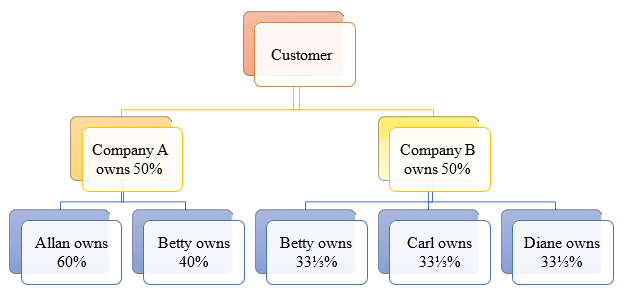
A covered financial need not independently investigate the legal entity customer's ownership structure and may accept and reasonably rely on the information regarding the status of beneficial owners presented to the financial institution by the legal entity customer's representative, provided that the institution has no knowledge of facts that would reasonably call into question the reliability of the information.
[Issued April 3, 2018]
B. 14. What means of identity verification are sufficient to reliably confirm beneficial ownership under the CDD Rule?
Covered financial institutions must verify the identity of each beneficial owner according to risk-based procedures that contain, at a minimum, the same elements financial institutions are required to use to verify the identity of individual customers under applicable CIP requirements. This includes the requirement to address situations in which the financial institution cannot form a reasonable belief that it knows the true identity of the legal entity customer's beneficial owners. Although the CDD Rule's beneficial ownership verification procedures must contain the same elements as existing CIP procedures, they are not required to be identical to them. For example, a covered financial institution's policies and procedures may state that the institution will accept photocopies of a driver's license from the legal entity customer to verify the beneficial owner(s)' identity if the beneficial owner is not present, which is not permissible in the CIP rules. (See Question B.16)
A financial institution's CIP must contain procedures for verifying customer identification, including describing when the institution will use documentary, non-documentary, or a combination of both methods for identity verification. Covered financial institutions may use the same methods to verify the identity of the beneficial owner of a legal entity customer. In addition, in contrast to the CIP rule, the CDD Rule expressly authorizes covered financial institutions to use photocopies or other reproduction documents for documentary verification.
Documentary verification may include unexpired government-issued identification evidencing nationality or residence and bearing a photograph or similar safeguard, such as a driver's license or passport. Non-documentary methods of verification may include contacting a beneficial owner; independently verifying the beneficial owner's identity through the comparison of information provided by the legal entity customer (or the beneficial owner, as appropriate) with information obtained from other sources; checking references with other financial institutions; and obtaining a financial statement.
Financial institutions should conduct their own risk-based analysis to determine the appropriate method(s) of verification and the appropriate documents or types of photocopies or reproductions to accept in order to comply with the beneficial owner verification requirement.
[Issued April 3, 2018; updated May 6, 2026]
B. 15. What address should be obtained for a legal entity customer's beneficial owner(s) to comply with the certification requirement — residential or business?
The address requirements for certification under the CDD Rule are the same as those outlined in the CIP rule. For an individual beneficial owner, covered financial institutions must obtain either a residential or a business street address. If neither is available, acceptable substitutes may include an Army Post Office (APO) or Fleet Post Office (FPO) box number, or the residential or business street address of next of kin or of another contact individual.
[Issued April 3, 2018; updated May 6, 2026]
B. 16. What process should a covered financial institution use to identify and verify the identity of a beneficial owner of a legal entity customer when the beneficial owner is unavailable to appear in person during the opening of a new account?
A covered financial institution may identify the beneficial owner(s) of a legal entity customer either by obtaining a completed Certification Form (Appendix A to the Rule) or equivalent information from the legal entity customer's representative and may rely on such information, provided that it has no knowledge of facts that would reasonably call into question the reliability of such information. Furthermore, covered financial institutions may verify the identity of a beneficial owner who does not appear in person, through a photocopy or other reproduction of a valid identity document, or by non-documentary means described in response to Question B.14 above.
[Issued April 3, 2018; updated May 6, 2026]
B. 17. If an individual named as a beneficial owner of a new legal entity account is an existing customer of the covered financial institution subject to the financial institution's CIP, is a covered financial institution still required to identify and verify the identity of this individual, or may it rely on the CIP identification and verification of the individual that it previously performed?
Pursuant to the CDD Rule, a covered financial institution must identify and verify the identity of the beneficial owner(s) of legal entity customers at the time each new account is opened. However, pursuant to the Account Opening Exceptive Relief Order, a covered financial institution may, but is not required to, limit its identification and verification of the identities of beneficial owners under the CDD Rule to the following scenarios: (1) when a legal entity customer first opens an account with a covered financial institution, (2) any time thereafter when the covered financial institution has knowledge of facts that would reasonably call into question the reliability of beneficial ownership information previously obtained about the legal entity customer, and (3) as needed based on a covered financial institution's risk-based procedures for conducting ongoing customer due diligence.
If the individual identified as the beneficial owner is an existing customer of the financial institution and is subject to the financial institution's CIP, a financial institution may rely on information in its possession to fulfill the identification and verification requirements, provided the existing information is up-to-date, accurate, and the legal entity customer's representative certifies or confirms (verbally or in writing) the accuracy of the pre-existing CIP information.
For example, a representative of X Corp opens a new account for the company at a covered financial institution and identifies John Doe, who has a personal account at the institution, as a 25% equity owner of X Corp. As required under the CIP rule, the institution identified and verified John Doe's identity at the time the personal account was established. In this situation, a covered financial institution may rely on the pre-existing CIP identification and verification information it maintains for John Doe, provided that X Corp's representative certifies or confirms (verbally or in writing) the accuracy of the pre-existing information on John Doe in order to comply with the Rule. The covered financial institution's records of beneficial ownership for the new account could cross-reference the relevant CIP records, and the verification of information would not need to be repeated.
[Issued April 3, 2018; updated May 6, 2026]
B. 18. Are covered financial institutions required to obtain or update beneficial ownership information during routine periodic reviews of existing accounts, absent risk-based concerns; that is, are such reviews a trigger for the application of the Rule's beneficial ownership requirements?
No. Covered financial institutions do not have an obligation to solicit or update beneficial ownership information as a matter of course during regular or periodic reviews, absent specific risk-based concerns. Financial institutions are required to develop and implement risk-based procedures for conducting ongoing customer due diligence, including regular monitoring to identify and report suspicious activity and, on a risk basis, to maintain and update customer information. Thus, periodic reviews are not by themselves a trigger to obtain or update beneficial ownership information. As stated in response to Question B.20, the obligation to obtain or update information is triggered when, in the course of normal monitoring, a financial institution becomes aware of information about a customer or an account, including a possible change of beneficial ownership information, relevant to assessing or reassessing the customer's overall risk profile. Absent such a risk-related trigger or event, collecting or updating of beneficial ownership information is at the discretion of the covered financial institution. Financial institutions may exercise this discretion to collect or update beneficial ownership information on customers as often as they deem appropriate.
[Issued April 3, 2018]
B. 19. If an update to beneficial ownership information is required, can the change(s) be made in a covered financial institution's databases without physically obtaining and re-certifying the information?
It depends. A covered financial institution must develop written internal policies, procedures, and internal controls with respect to collecting, maintaining, and updating a legal entity's beneficial ownership information. The CDD Rule requires the covered financial institutions monitor, and on a risk-basis, update the customer information, including the beneficial ownership information, and does not require re-certification when the information is up-to-date and accurate. Covered financial institutions may therefore update their records to reflect a change of information for an existing beneficial owner using the same or similar processes the institution implemented to record account information it obtains from customers in connection with the institution's account opening processes. For example, if the update were only to a change of address for an existing beneficial owner whose identity information has already been collected and verified, then full re-certification would likely not be required. In this circumstance, it may be reasonable for the covered financial institution to communicate verbally with the legal entity customer to confirm the accuracy of the change of address and reflect such information in its databases. If, however, the updated information were a change of beneficial ownership, then the new beneficial owner's identity would need to be collected, certified, and verified.
[Issued April 3, 2018; updated May 6, 2026]
B. 20. Does FinCEN distinguish between the requirements for identifying and verifying beneficial owner information at the time of a new account opening and at the time of a triggering event?
No. Whether a covered financial institution identifies and verifies the identity of the beneficial owner at the time a legal entity initially opens a new account or at the time of a triggering event, the fundamental elements of identification and verification are the same. That is, covered financial institutions must identify each beneficial owner by obtaining their name, date of birth, address, and identifying number (such as a social security number or other identifying number permissible under the CIP rule), and verify their identities. However, financial institutions' written policies, procedures, and processes, as well as the sum of information, may differ with respect to the collection of information at the time a legal entity customer opens a new account or at the time an existing account is updated after a triggering event.
The breadth of information collected as the result of a triggering event during the normal course of monitoring to identify and report suspicious activity and to maintain and update customer information should be determined by what information has changed. That is, only the information that has changed must be updated (e.g., changing the address of the beneficial owner). To the extent that the triggering event results in a determination that the beneficial ownership of the legal entity may have changed entirely, the identity of any new beneficial owner(s) must be collected, certified, and verified, consistent with section 1010.230(b).
[Issued April 3, 2018; updated May 6, 2026]
B. 21. Are covered financial institutions required to identify and verify the identity of the beneficial owners that own 25% or more of the ownership interests of a pooled investment vehicle whose operators or advisers are not excluded from the definition of legal entity customer?
No. Although the CDD Rule requires covered financial institutions to collect and verify the identity of beneficial owners who own 25% or more of the equity interests of a legal entity customer, in general, institutions are not required to look through a pooled investment vehicle to identify and verify the identity of any individuals who own 25% or more of its equity interests. Because of the way in which ownership of a pooled investment vehicle fluctuates, it would be impractical for covered financial institutions to collect and verify ownership identity for this type of entity. Therefore, there is no requirement that the financial institution should request the customer to look through the pooled investment vehicle to determine and report any individual's equity interest. However, covered financial institutions must collect beneficial ownership information for the pooled investment vehicle under the control prong to comply with the Rule (i.e., an individual with significant responsibility to control, manage, or direct the vehicle; such individuals could be, e.g., a portfolio manager, commodity pool operator, commodity trading advisor, or general partner of the vehicle). In cases where such manager, operator or advisor is itself an entity, then it would be necessary to identify an individual with responsibility to control, manage or direct the manager, operator, advisor or general partner.
[Issued April 3, 2018; updated May 6, 2026]
B. 22. When 25% or more of the equity interests of a legal entity customer are owned by a trust that is overseen by multiple trustees, are covered financial institutions required to identify and verify the identity of all trustees?
No. If a trust owns directly or indirectly, through any contract, arrangement, understanding, relationship or otherwise, 25% or more of the equity interests of a legal entity customer, the beneficial owner under the ownership/equity prong is the trustee. Where there are multiple trustees, financial institutions are expected to collect and verify the identity of, at a minimum, one trustee of a multi-trustee trust who owns 25% or more of the equity interests of a legal entity customer that is not subject to an exclusion. A covered financial institution may choose to identify additional trustees as part of its customer due diligence, based on its risk assessment and the customer risk profile and in accordance with the institution's account opening procedures.
[Issued April 3, 2018; updated May 6, 2026]
B. 23. If a legal entity is the trustee (e.g., law firm, bank trust department, etc.) of a trust that owns 25% or more of the equity interests of a legal entity customer, can that entity be identified as a beneficial owner under the ownership/equity prong or does a natural person need to be so identified?
If a trust owns directly or indirectly, through any contract, arrangement, understanding, relationship, or otherwise, 25% or more of the equity interests of a legal entity customer, the beneficial owner for purposes of the ownership/equity prong is the trustee, regardless of whether the trustee is a natural person or a legal entity. In circumstances where a natural person does not exist for purposes of the ownership/equity prong, a natural person would not be identified. However, a covered institution should collect identification information on the legal entity trustee as part of its CIP, consistent with the covered institution's risk assessment and the customer risk profile.
In addition to the ownership/equity prong, covered financial institutions are also required to identify and verify a natural person as the beneficial owner of the legal entity customer under the control prong to comply with the Rule.
The ownership/equity and control prongs, although related, are independent requirements. Thus, satisfaction of, or exclusion from, regulatory obligations under one prong does not mean a covered financial institution's obligations under the other prong are also satisfied or excluded.
[Issued April 3, 2018; updated May 6, 2026]
B. 24. Are covered financial institutions required to collect or update beneficial ownership information on customers with accounts opened prior to May 11, 2018, the Rule's applicability date?
Financial institutions are not required to conduct retroactive reviews to obtain beneficial ownership information from customers with accounts opened prior to May 11, 2018. The obligation to obtain or update beneficial ownership information on legal entity customers with accounts established before May 11, 2018, is triggered when a financial institution becomes aware of information about the customer during the course of normal monitoring relevant to assessing or reassessing the risk posed by the customer, and such information indicates a possible change of beneficial ownership.
[Issued April 3, 2018; updated May 6, 2026]
C. Account
C. 1. How is "account" defined in the CDD Rule?
In order to maintain consistency with CIP, FinCEN added to the CDD Rule the same definition of the term "account" that is in the CIP rules for banks, brokers or dealers in securities, mutual funds, and futures commission merchants and introducing brokers in commodities.
[Issued July 19, 2016]
C. 2. What is a "new account" and does opening a new account require identification and verification of a legal entity customer's beneficial owner(s)?
The CDD Rule defines a "new account" as each account opened at a covered financial institution by a legal entity customer on or after the May 11, 2018, applicability date. Pursuant to the CDD Rule, a covered financial institution must identify and verify the identity of the beneficial owner(s) of legal entity customers at the time each new account is opened unless the customer is otherwise excluded or the account is exempted. However, pursuant to the Account Opening Exceptive Relief Order, a covered financial institution may, but is not required to, limit its identification and verification of the identities of beneficial owners under the CDD Rule to the following scenarios: (1) when a legal entity customer first opens an account with a covered financial institution, (2) any time thereafter when the covered financial institution has knowledge of facts that would reasonably call into question the reliability of beneficial ownership information previously obtained about the legal entity customer, and (3) as needed based on a covered financial institution's risk-based procedures for conducting ongoing customer due diligence. Refer to the Account Opening Exceptive Relief Order for further details.
[Issued July 19, 2016; updated May 6, 2026]
C. 3. Does a covered financial institution have to obtain beneficial information on existing accounts?
No. The rule does not cover existing accounts that were opened before the applicability date.
[Issued July 19, 2016]
C. 4. Are there any type of accounts that are not covered by the CDD Rule?
Yes. Subject to certain limitations, covered financial institutions are also not required to identify and verify the identity of the beneficial owner(s) of a legal entity customer when the customer opens any of the following four categories of accounts:
- Accounts established at the point-of-sale to provide credit products, solely for the purchase of retail goods and/or services at these retailers, up to a limit of $50,000;
- Accounts established to finance the purchase of postage and for which payments are remitted directly by the financial institution to the provider of the postage products;
- Accounts established to finance insurance premiums and for which payments are remitted directly by the financial institution to the insurance provider or broker; and
- Accounts established to finance the purchase or lease of equipment and for which payments are remitted directly by the financial institution to the vendor or lessor of this equipment.
These exemptions will not apply under either of the following two circumstances:
- If the accounts are transaction accounts through which a legal entity customer can make payments to, or receive payments from, third parties; and
- If there is the possibility of a cash refund for accounts opened to finance purchase of postage, insurance premium, or equipment leasing. If there is the possibility of a cash refund, the financial institution must identify and verify the identity of the beneficial owner(s) either at the initial remittance, or at the time such refund occurs.
[Issued July 19, 2016; updated May 6, 2026]
C. 5. FinCEN understands that after a covered financial institution (particularly in the securities and futures industries) opens a new account for a legal entity customer and identifies its beneficial ownership, the financial institution may subsequently open one or more additional accounts or subaccounts for that customer—for the institution's own recordkeeping or operational purposes and not at the customer's specific request—so that the customer may, for example invest in particular products or implement particular trading strategies. Would such accounts fall within the definition of "new accounts" for purposes of the beneficial ownership requirement?
The beneficial ownership requirement applies to a "new account," which is defined to mean "each account opened … by a legal entity customer" [emphasis added]. An account (or subaccount) relating to a legal entity customer will not be considered a "new account" or an "account" for purposes of the CDD Rule when a financial institution creates such an account (or subaccount) for its own administrative or operational purposes and not at the customer's request—such as to accommodate a specific trading strategy—and the financial institution has already collected beneficial ownership information on such legal entity customer. The distinction between such accounts opened by customers and those opened by financial institutions for their own administrative or operational purposes is a facts-and-circumstances determination, and financial institutions should document the basis for their determinations.
However, if a legal entity customer subsequently opens a new account (or subaccount) with a covered financial institution, the covered financial institution may, but is not required to, limit its identification and verification of the identities of beneficial owners under the CDD Rule to the following scenarios: (1) when a legal entity customer first opens an account with a covered financial institution, (2) any time thereafter when the covered financial institution has knowledge of facts that would reasonably call into question the reliability of beneficial ownership information previously obtained about the legal entity customer, and (3) as needed based on a covered financial institution's risk-based procedures for conducting ongoing customer due diligence. This is pursuant to the Account Opening Exceptive Relief Order, absent knowledge or need as identified in scenarios (2) or (3) from the Account Opening Exceptive Relief Order and in Question B.1.b. Refer to the Account Opening Exceptive Relief Order for details.
[Issued April 3, 2018; updated May 6, 2026]
C. 6. Are financial institutions required to have their legal entity customers certify the beneficial owners for existing customers during the course of a financial product renewal (e.g., a loan renewal or certificate of deposit)?
Consistent with the definition of “account” in the CIP rules and subsequent interagency guidance, each time a loan is renewed or a certificate of deposit is rolled over, the bank establishes another formal banking relationship, and a new account is established. Pursuant to the CDD Rule, covered financial institutions are required to obtain information on the beneficial owners of a legal entity that opens a new account, meaning (in the case of a bank) for each new formal banking relationship established, even if the legal entity is an existing customer.
Under that framework, covered financial institutions must obtain or request confirmation of certified beneficial ownership information of the legal entity customer product and service renewal at the time of the first renewal following that date. At the time of each subsequent renewal, to the extent that the legal entity customer and the financial service or product (e.g., loan or CD) remains the same, the customer certifies or confirms that the beneficial ownership information previously obtained is accurate and up-to-date, and the institution has no knowledge of facts that would reasonably call into question the reliability of the information, the financial institution would not be required to collect the beneficial ownership information again. In the case of a loan renewal or CD rollover, because we understand that these products are not generally treated as new accounts by the industry and the risk of money laundering is very low, if at the time the customer certifies its beneficial ownership information, it also agrees to notify the financial institution of any change in such information, such agreement can be considered the certification or confirmation from the customer and should be documented and maintained as such, so long as the loan or CD is outstanding.
However, pursuant to the Account Opening Exceptive Relief Order, opening a new account for an existing legal entity customer does not, by itself, require a covered financial institution to identify and verify the identity of the legal entity customer’s beneficial owner(s). A covered financial institution may instead—but is not required to—limit its identification and verification of the identities of beneficial owners under the CDD Rule to the following scenarios: (1) when a legal entity customer first opens an account with a covered financial institution, (2) any time thereafter when the covered financial institution has knowledge of facts that would reasonably call into question the reliability of beneficial ownership information previously obtained about the legal entity customer, and (3) as needed based on a covered financial institution’s risk-based procedures for conducting ongoing customer due diligence. Consequently, covered financial institutions may choose not to obtain or request confirmation of certified beneficial ownership information from a legal entity customers at the time of renewal of a financial product or service, absent knowledge or need as identified in scenarios (2) or (3) from the Account Opening Exceptive Relief Order and in Question B.1.b. Refer to the Account Opening Exceptive Relief Order for details.
[Issued April 3, 2018; updated May 6, 2026]
D. Certification Form
D. 1. Are covered financial institutions required to use the beneficial ownership Certification Form (Appendix A to the Rule), and if so, how can they obtain a copy of the Form?
No. There is no requirement that covered financial institutions use the Certification Form. Rather, the form is optional and provided for the convenience of covered financial institutions as one possible method to obtain the required beneficial ownership information. Financial institutions may choose to comply with the requirements of the Rule by using another method, such as through the institutions' own forms, or any other means that comply with the substantive requirements of this obligation. Covered financial institutions should retain the form and not file it with FinCEN.
Covered financial institutions may obtain a fillable and non-fillable copy of the optional Certification Form in Appendix A of the CDD Rule at www.fincen.gov/resources/filing-information.
[Issued April 3, 2018]
D. 2. If a covered financial institution has updated the beneficial ownership information on the account(s) of a legal entity customer, and subsequently a new account is opened on behalf of the same legal entity customer, is the institution required to retain all sets of beneficial ownership documentation, thereby retaining up to three sets of information: the original set collected at account opening, the updated set, and a third, a duplicate of the second (updated) set for the new account?
Covered financial institutions are required to retain all beneficial ownership information collected about a legal entity customer for specified periods. Identifying information, including the Certification Form or its equivalent, must be maintained for a period of five years after that account is closed. All verification records must be retained for a period of five years after the record is made.
Therefore, whether a financial institution must retain a set of identification or verification records is dependent upon the date an account is opened and closed, or the date a record is made. For example, if a covered financial institution relies on pre-existing beneficial ownership information in its possession as true and accurate identification information when opening a new account for a legal entity customer, the financial institution should maintain the original records, and any updated information, including a record of any verbal or written confirmation of pre-existing information until five years after the closing of the new account in order to comply with the recordkeeping requirements in the regulation. Covered financial institutions must also retain a description of every document relied on for verification, any non-documentary methods and results of measures undertaken for verification, as well as the resolution of any substantive discrepancies discovered in identifying and verifying the identification information for five years after the record is made.
[Issued April 3, 2018; updated May 6, 2026]
D. 3. If a legal entity customer opens multiple accounts at a covered financial institution (whether or not simultaneously), must the financial institution identify and verify the customer's beneficial ownership for each account?
Pursuant to the CDD Rule, covered financial institutions must identify and verify the legal entity customer's beneficial ownership information for each new account opening, regardless of the number of accounts opened or over a specific period of time. However, an institution that has already obtained a Certification Form (or its equivalent) for the beneficial owner(s) of the legal entity customer may rely on that information to fulfill the beneficial ownership requirement for subsequent accounts, provided the customer certifies or confirms (verbally or in writing) that such information is up-to-date and accurate at the time each subsequent account is opened and the financial institution has no knowledge of facts that would reasonably call into question the reliability of such information. The institution would also need to maintain a record of such certification or confirmation, including for both verbal and written confirmations by the customer.
Additionally, pursuant to the Account Opening Exceptive Relief Order, a covered financial institution may limit its identification and verification of identities of the beneficial owner(s) of a legal entity customer to three scenarios: (1) when the legal entity customer first opens an account with a covered financial institution; (2) any time thereafter when the covered financial institution has knowledge of facts that would reasonably call into question the reliability of beneficial ownership information previously obtained about the legal entity customer; and (3) as needed based on a covered financial institution's risk-based procedures for conducting ongoing customer due diligence. Refer to the Account Opening Exceptive Relief Order for further details. When scenario (3) arises—that is, when a covered financial institution determines, based on its risk-based procedures for conducting ongoing customer due diligence, that it needs to identify and verify the beneficial owner(s) of a legal entity customer—the covered financial institution may rely on beneficial ownership information previously obtained in accordance with 31 CFR 1010.230(b)(1), provided the customer certifies or confirms (verbally or in writing) that such information is up-to-date and accurate. The covered financial institution must maintain a record of such certification or confirmation, including for both verbal and written confirmations by the customer.
[Issued April 3, 2018; updated May 6, 2026]
E. Legal Entity Customer
E. 1. Who is a "legal entity customer"?
The CDD Rule defines a "legal entity customer" as a corporation, limited liability company, other entity created by the filing of a public document with a Secretary of State or similar office, a general partnership, and any similar entity formed under the laws of a foreign jurisdiction that opens an account. The definition also includes limited partnerships, business trusts that are created by a filing with a state office, and any other entity created in this manner.
A legal entity customer does not include sole proprietorships, unincorporated associations, or natural persons opening accounts on their own behalf.
[Issued July 19, 2016]
E. 2. Are there any entities that are excluded from the definition of the legal entity customer and for which a covered financial institution is not required to obtain beneficial ownership information?
Yes. The CDD Rule excludes from the definition of legal entity customer, certain entities that are subject to Federal or State regulation and for which information about their beneficial ownership and management is available from the Federal or State agencies, such as:
- Financial institutions regulated by a Federal functional regulator or a bank regulated by a State bank regulator;
- Certain exempt persons for purposes of the currency transactions reporting obligations:
- A department or agency of the United States, of any State, or of any political subdivision of a State;
- Any entity established under the laws of the United States, or any State, or of any political subdivision of any State, or under an interstate compact;
- Any entity (other than a bank) whose common stock or analogous equity interests are listed on the New York, American, or NASDAQ stock exchange;
- Any entity organized under the laws of the United States or of any State at least 51% of whose common stock or analogous equity interests are held by a listed entity;
- Issuers of securities registered under section 12 of the Securities Exchange Act of 1934 (SEA) or that is required to file reports under 15(d) of that Act;
- An investment company, as defined in section 3 of the Investment Company Act of 1940, registered with the U.S. Securities and Exchange Commission (SEC);
- An SEC-registered investment adviser, as defined in section 202(a)(11) of the Investment Advisers Act of 1940;
- An exchange or clearing agency, as defined in section 3 of the SEA, registered under section 6 or 17A of that Act;
- Any other entity registered with the SEC under the SEA;
- A registered entity, commodity pool operator, commodity trading advisor, retail foreign exchange dealer, swap dealer, or major swap participant, defined in section 1a of the Commodity Exchange Act, registered with the Commodity Futures Trading Commission; and
- A public accounting firm registered under section 102 of the Sarbanes-Oxley Act.
Additional regulated entities:
• A bank holding company, as defined in section 2 of the Bank Holding Company Act of 1956 (12 U.S.C. 1841) or savings and loan holding company, as defined in section 10(n) of the Home Owners' Loan Act (12 U.S.C. 1467a(n));
• A pooled investment vehicle operated or advised by a financial institution excluded from the definition of legal entity customer under the CDD Rule;
• An insurance company regulated by a State; and
• A financial market utility designated by the Financial Stability Oversight Council under Title VIII of the Dodd-Frank Wall Street Reform and Customer Protection Act of 2010.
Excluded Foreign Entities:
• A foreign financial institution established in a jurisdiction where the regulator of such institution maintains beneficial ownership information regarding such institution;
• A non-U.S. governmental department, agency or political subdivision that engages only in governmental rather than commercial activities; and
• Any legal entity only to the extent that it opens a private banking account subject to 31 CFR 1010.620.
[Issued July 19, 2016]
E. 3. Are trusts included in the definition of legal entity customer?
No. The definition of legal entity customer only includes statutory trusts created by a filing with the Secretary of State or similar office. Otherwise, it does not include trusts. This is because a trust is a contractual arrangement between the person who provides the funds or other assets and specifies the terms (i.e., the grantor/settlor) and the person with control over the assets (i.e., the trustee), for the benefit of those named in the trust deed (i.e., the beneficiaries). Formation of a trust does not generally require any action by the state.
The CDD Rule does not supersede existing obligations and practices regarding trusts generally. The preamble to each of the CIP rules notes that, while financial institutions are not required to look through a trust to its beneficiaries, they "may need to take additional steps to verify the identity of a customer that is not an individual, such as obtaining information about persons with control over the account." We understand that where trusts are direct customers of financial institutions, financial institutions generally also identify and verify the identity of trustees, because trustees will necessarily be signatories on trust accounts. Furthermore, under supervisory guidance for banks, "in certain circumstances involving revocable trusts, the bank may need to gather information about the settlor, grantor, trustee, or other persons with the authority to direct the trustee, and who thus have authority or control over the account, in order to establish the true identity of the customer."
[Issued July 19, 2016; updated May 6, 2026]
E. 4. Are sole proprietorships formed by spouses or other unincorporated associations considered legal entity customers under the CDD Rule?
No. Sole proprietorships—individual or spousal—and unincorporated associations are not legal entity customers as defined by the Rule, even though such businesses may file with the Secretary of State in order to register a trade name or establish a tax account. This is because neither a sole proprietorship nor an unincorporated association is a separate legal entity from the associated individual(s), and therefore beneficial ownership is not inherently obscured.
[Issued April 3, 2018; updated May 6, 2026]
E. 5. What methods should covered financial institutions use to verify eligibility for exclusion from the definition of a "legal entity customer"?
Several types of legal entity customers are excluded from the collection and verification requirements of the Rule, under section 1010.230(e)(2), because, for example, their regulators require the reporting of beneficial ownership information or such information is publicly available. A financial institution may rely on information provided by the legal entity customer to determine whether the legal entity is excluded from the definition of a legal entity customer, provided that it has no knowledge of facts that would reasonably call into question the reliability of such information. Whether a financial institution has such knowledge would depend on the facts and circumstances at the time an account is opened. Covered financial institutions must establish and maintain written risk-based procedures reasonably designed to identify and verify the identity of the beneficial owners of all legal entity customers at the time a new account is opened, unless the customer is otherwise excluded from the definition of legal entity customer. Covered financial institutions are expected to address and specify, in their risk-based written policies and procedures, the type of information they will obtain and reasonably rely upon to determine eligibility for exclusions.
[Issued April 3, 2018]
E. 6. Are covered financial institutions limited to the Internal Revenue Code (IRC) definitions of charities, non-profits, or similar entities when assessing their eligibility for exclusion from the definition of legal entity customer?
No. The exclusion from the definition of legal entity customer for charities and non-profit entities is not limited to those entities that meet the definition or description of charitable, nonprofit, or similar entities under the IRC. The Rule does not rely on the tax-exempt status of an entity as described in the IRC. All nonprofit entities—whether or not tax-exempt—that are established as a nonprofit, or nonstock corporation, or similar entity that has been validly organized with the proper State authority are excluded from the ownership/equity prong of the requirement because nonprofit entities generally do not have ownership interests. Financial institutions, however, are required to collect beneficial ownership information under the control prong from any such entity.
[Issued April 3, 2018; updated May 6, 2026]
E. 7. Are companies publicly traded in the United States and entities listed on foreign exchanges excluded from the definition of legal entity customer and, therefore, excluded by the Rule?
Companies traded publicly in the United States are excluded from the definition of legal entity customer. Specifically, the Rule excludes from the definition of legal entity customer certain entities that are considered "exempt persons" under 31 CFR 1020.315(b). This includes any company (other than a bank) whose common stock or analogous equity interests are listed on the New York Stock Exchange, the American Stock Exchange (currently known as NYSE American), or NASDAQ stock exchange. The Rule also excludes a U.S. entity when at least 51% of its common stock or analogous equity interest is held by a listed entity. These U.S. companies are excluded from the Rule because they are subject to public disclosure and reporting requirements that provide information similar to what would otherwise be collected under the Rule.
Companies listed on foreign exchanges are not excluded from the definition of legal entity customer. Such companies may not be subject to the same or similar public disclosure and reporting requirements as companies publicly traded in the United States and, therefore, collecting beneficial ownership information for them is required.
[Issued April 3, 2018; updated May 6, 2026]
E. 8. May covered financial institutions take a risk-based approach for collecting beneficial ownership information from legal entity customers listed on foreign exchanges?
No. Financial institutions may not take a "risk-based approach" to collecting the required beneficial ownership information from legal entity customers that are listed on foreign exchanges, because such institutions are not excluded from the definition of legal entity customer. However, as they may with regard to other legal entity customers, whether listed or not, covered institutions may rely on the public disclosures of such entities, absent any reason to believe such information is inaccurate or not up-to-date.
[Issued April 3, 2018]
E. 9. Does the exclusion for foreign financial institutions from the Rule's definition of "legal entity customer" depend on whether the beneficial ownership requirements applied by such institution's foreign regulator match U.S. requirements?
No. For purposes of beneficial ownership identification, the CDD Rule excludes from the definition of "legal entity customer" a foreign financial institution created in a non-U.S. jurisdiction when the foreign regulator for that financial institution collects and maintains information on the beneficial owner(s) of the regulated institution. The CDD Rule does not require covered financial institutions to research the specific transparency requirements imposed on a foreign financial institution by its regulator and compare them with those imposed on U.S. financial institutions by U.S. Federal functional regulators. However, if the foreign regulator does not collect and maintain beneficial ownership information on the foreign financial institution it regulates, then U.S. financial institutions will have to collect and maintain beneficial ownership information on accounts opened by foreign financial institutions in compliance with the CDD Rule. As with any exclusion, covered financial institutions may rely on the representations of its legal entity customer as to whether an exclusion applies, provided that they have no knowledge of facts that would reasonably call into question the reliability of such representation. (See Question E.5.)
For purposes of existing customer due diligence requirements, covered financial institutions that maintain correspondent accounts for foreign financial institutions are already required to establish and maintain specific risk-based due diligence procedures and controls for such accounts that include consideration of all relevant factors, and are required to identify beneficial ownership for certain high-risk foreign banks. These correspondent accounts will continue to be subject to these existing requirements rather than the requirements set forth in the AML Program requirements contained in the CDD Rule.
[Issued April 3, 2018; updated May 6, 2026]
E. 10. Will the U.S. Government maintain a list of non-U.S. jurisdictions where the regulator of financial institutions within that jurisdiction maintains beneficial ownership information regarding the financial institutions they regulate or supervise?
No. Covered financial institutions should contact the relevant foreign regulator or use other reliable means to ascertain whether the foreign regulator maintains beneficial ownership information for the financial institutions that it regulates or supervises.
[Issued April 3, 2018]
E. 11. What types of entities would be considered a "non-U.S. governmental department, agency, or political subdivision that engages only in governmental rather than commercial activities" such that they would qualify for exclusion from the definition of a legal entity customer?
Examples of legal entity customers that would be considered non-U.S. governmental entities engaged in only governmental and not commercial activities include entities that are owned and operated by a non-U.S. government agency or political subdivision, such as embassies or consulates, as well as entities that are instrumentalities of a foreign government, such as government-owned enterprises engaging in activities that are exclusively governmental in nature, that is, activities involving the direct exercise of legislative, executive, or judicial authority and which do not involve taking profits from the endeavor. Those State-owned enterprises engaged in profit-seeking activities, including, among others, sovereign wealth funds, airlines, or oil companies, would not qualify for the legal entity customer exclusion. Generally, many State-owned enterprises may not have an individual that owns at least a 25% equity interest because a governmental department, agency, or political subdivision holds such interest.
In these circumstances, a covered financial institution would only be required to identify an individual under the control prong. Similarly, with respect to a State-owned enterprise that is a pooled investment vehicle not subject to another exclusion, financial institutions would be required to obtain beneficial ownership information under the control prong but not under the ownership/equity prong of the definition of beneficial owner.
Furthermore, similar to other instances of identification and verification within the Rule's context, a covered financial institution may reasonably rely upon the representations of the legal entity customer, absent knowledge of facts that would call into question the reliability of the beneficial ownership information provided to the financial institution.
[Issued April 3, 2018; updated May 6, 2026]
E. 12. Does the point of sale exception only apply to accounts opened at the cash register or does it refer to all applications for credit accounts that are for use at the private label retailer only?
The CDD Rule provides an exemption from the requirements for a covered financial institution that "opens an account for a legal entity customer that is: [a]t the point-of-sale to provide credit products, including commercial private label credit cards, solely for the purchase of retail goods and/or services at these retailers, up to a limit of $50,000." The point of sale exemption is provided for retail credit accounts opened to facilitate purchases made at the retailer because of the very low risk posed by opening such accounts at the brick and mortar store.
[Issued April 3, 2018]
E. 13. What kind of businesses and equipment are covered under the equipment finance exemption?
The CDD Rule reflects FinCEN's understanding that businesses require financing to obtain equipment to conduct ongoing business operations. Many such businesses, including both large and small businesses, open accounts solely for the purpose of financing the purchase or lease of that equipment. Subject to certain limitations, the CDD Rule provides an exemption from the requirement to identify and verify the identity of a legal entity customer's beneficial owners for equipment finance and lease accounts established at a covered financial institution because of the low risk for money laundering posed by these accounts. The exemption is intended to cover business equipment such as farm equipment, construction machinery, aircraft, computers, printers, photocopiers, and automobiles that a business purchases or leases. The Rule does not limit the exemption to small businesses. Regardless of the application of the exemption, a covered financial must comply with all other applicable BSA/AML obligations, which may include the obligation to file SARs where there is a suspicion that the equipment may be used to facilitate criminal activity.
[Issued April 3, 2018; updated May 6, 2026]
E. 14. Does the equipment lease and purchase exemption apply when the customer leases directly from the covered institution?
Yes, consider the following. Aviation LLC, which operates several flight training schools, visits Aircraft Vendor to acquire five aircraft for its flight training schools. Aviation LLC selects the aircraft and contacts the Lessor Covered Financial Institution to obtain the necessary equipment finance to acquire the aircraft. After a review of the aircraft and Aviation LLC's business, the Lessor Covered Financial Institution agrees to purchase the aircraft from Aircraft Vendor and then lease them to Aviation LLC for a specified rent amount and duration. The Lessor Covered Financial Institution purchases the aircraft, pays the purchase price directly to Aircraft Vendor, and obtains title to the aircraft as collateral. The Lessor Covered Financial Institution then enters into a lease agreement with Aviation LLC, which opens an account at the financial institution solely for the purpose of obtaining the aircraft and making periodic rent payments. There is no possibility of a cash refund to Aviation LLC under the lease terms.
The equipment lease and purchase exemption would apply because the account established at the covered financial institution meets all of the requirements of the exemption, which are that: (1) the account's purpose is to finance the purchase or leasing of equipment; (2) payments are remitted directly by the financial institution to the vendor or lessor; and (3) there is no possibility of a cash refund on the account activity. First, Covered Financial Institution remit full payment directly to the vendor and obtained title to the equipment in order to lease the equipment to the legal entity customer. Second, Aviation LLC opened the account solely for the purpose of financing an equipment lease to acquire aircraft for its training schools. Finally, there is no possibility of a cash refund to Aviation LLC. As noted in the final rule, accounts created to provide financing for equipment lease or purchase, subject to certain conditions, are exempt from the beneficial ownership requirement because they present a low risk for money laundering and terrorist financing.
[Issued April 3, 2018; updated May 6, 2026]
F. Nature and Purpose/Customer Risk Profile/Ongoing Monitoring
F. 1. The CDD Rule requires financial institutions to understand "the nature and purpose of customer relationships to develop a customer risk profile." What type of information should financial institutions collect to satisfy this requirement and may the documentation of the nature and purpose of a customer relationship be made on a risk-basis?
Understanding the nature and purpose of a customer relationship in order to develop a customer risk profile is an important part of ongoing customer due diligence, and is required for all customers and accounts. An understanding based on category of customer means that for certain lower-risk customers, a financial institution's understanding of the nature and purpose of a customer relationship can be developed by inherent or self-evident information, such as the type of customer or type of account, service, or product or other basic information about the customer, including information obtained at first account opening.
The profile may, but need not, include a system of risk ratings or categories of customers. Accordingly, the documentation that is required to demonstrate an understanding of the nature and purpose of a customer relationship would vary with the type of customer, account, service, or product.
[Issued April 3, 2018]
F. 2. Once the nature and purpose of a customer relationship has been established, what are FinCEN's expectations concerning the use of this information?
Understanding the nature and purpose of a customer relationship—the information gathered about a customer at account opening—is essential to developing a customer risk profile. This information should be used to develop a baseline against which customer activity, such as the customer's expected use of wires or typical number of deposits in a month, can be assessed for possible suspicious activity reporting. If account activity changes, particularly with regard to what should be anticipated based on the original nature and purpose of the account, risk-based monitoring may identify a need to update customer information, including, as appropriate, beneficial ownership.
[Issued April 3, 2018]
F. 3. In understanding the nature and purpose of customer relationships, are financial institutions required to develop and document customer risk profiles for self-evident products or customer type (e.g., a safe deposit box)?
Financial institutions must implement risk-based procedures as part of their AML program to demonstrate an understanding of the nature and purpose of customer relationships to develop customer risk profiles. Customer risk profiles refer "to the information gathered about a customer at account opening used to develop a baseline against which customer activity can be assessed for suspicious activity reporting. This may include self-evident information such as the type of customer, or type of account, service or product." It is reasonable that in the case of certain products, such as safety deposit boxes, the nature and purpose are self-evident and therefore no additional documentation would be needed to demonstrate an understanding of their nature and purpose, beyond the documentation to establish the particular type of account.
[Issued April 3, 2018; updated May 6, 2026]
F. 4. Is it a requirement under the CDD Rule that covered financial institutions:
- Collect information about expected activity on all customers at account opening, or on an ongoing or periodic basis;
- Conduct media searches or screening for news articles on all customers or other related parties, such as beneficial owners, either at account opening, or on an ongoing or periodic basis; or
- Collect information that identifies underlying transacting parties when a financial institution offers correspondent banking or omnibus accounts to other financial institutions (i.e., a customer's customer)?
The CDD Rule does not categorically require: (1) the collection of any particular customer due diligence information (other than that required to develop a customer risk profile, conduct monitoring, and collect beneficial ownership information); (2) the performance of media searches or particular screenings; or (3) the collection of customer information from a financial institution's clients when the financial institution is a customer of a covered financial institution.
A covered financial institution may assess, on the basis of risk, that a customer's risk profile is low, and that, accordingly, additional information is not necessary for the covered financial institution to develop its understanding of the nature and purpose of the customer relationship. In other circumstances, the covered financial institution might assess, on the basis of risk, that a customer presents a higher risk profile and, accordingly, collect more information to better understand the customer relationship.
Covered financial institutions must establish policies, procedures, and processes for determining whether and when, on the basis of risk, to update customer information to ensure that customer information is current and accurate. Information collected throughout the relationship is critical in understanding the customer's transactions in order to assist the financial institution in determining when transactions are potentially suspicious.
[Issued August 3, 2020]
F. 5. Is it a requirement under the CDD Rule that covered financial institutions:
- Use a specific method or categorization to risk rate customers; or
- Automatically categorize as "high risk" products and customer types that are identified in government publications as having characteristics that could potentially expose the institution to risks?
It is not a requirement that covered financial institutions use a specific method or categorization to establish a customer risk profile. Further, covered financial institutions are not required or expected to automatically categorize as "high risk" products or customer types listed in government publications.
Various government publications provide information and discussions on certain products, services, customers, and geographic locations that present unique challenges and exposures regarding illicit financial activity risks. However, even within the same risk category, a spectrum of risks may be identifiable and due diligence measures may vary on a case-by-case basis.
A covered financial institution should have an understanding of the money laundering, terrorist financing, and other financial crime risks of its customers to develop the customer risk profile. Furthermore, the financial institution's program for determining customer risk profiles should be sufficiently detailed to distinguish between significant variations in the risks of its customers. There are no prescribed risk profile categories, and the number and detail of these categories can vary.
[Issued August 3, 2020]
F. 6. Is it a requirement under the CDD Rule that financial institutions update customer information on a specific schedule?
There is no categorical requirement that financial institutions update customer information on a continuous or periodic schedule. The requirement to update customer information is risk based and occurs as a result of normal monitoring. Should the financial institution become aware as a result of its ongoing monitoring of a change in customer information (including beneficial ownership information) that is relevant to assessing the risk posed by the customer, the financial institution must update the customer information accordingly. Additionally, if this customer information is relevant to assessing the risk of a customer relationship, then the financial institution should reassess the customer risk profile/rating and follow established financial institutions policies, procedures, and processes for maintaining or changing the customer risk profile/rating. However, financial institutions, on the basis of risk, may choose to review customer information on a regular or periodic basis.
[Issued August 3, 2020]
F. 7. Are covered financial institutions required to implement different processes than currently established to comply with the Rule's ongoing monitoring and updating requirement?
To the extent that a covered financial institution has monitoring processes in place that allow the institution to meet the Rule's requirements, such institution may use its existing monitoring processes to comply with customer due diligence monitoring and updating obligations. As the preamble to the Rule states, "current industry practice to comply with existing expectations for SAR reporting should already satisfy this proposed requirement."
[Issued April 3, 2018; updated May 6, 2026]
G. Other
G. 1. Are covered financial institutions required to comply with the OFAC regulations with respect to beneficial ownership information?
Covered financial institutions should use beneficial ownership information as they use other information they gather regarding customers (e.g., through compliance with the CIP requirements), including for compliance with OFAC-administered sanctions.
[Issued July 19, 2016]
G. 2. Do covered financial institutions now have additional obligations under section 314(a) for beneficial ownership information?
FinCEN does not expect the information obtained under the CDD Rule to add additional 314(a) requirements for financial institutions. The regulation implementing section 314(a) does not require the reporting of beneficial ownership information associated with an account or transaction matching a named subject in a 314(a) request. Covered financial institutions are required to search their records for accounts or transactions matching a named subject and report whether a match exists using the identifying information provided in the request.
[Issued July 19, 2016]
G. 3. Under what circumstances should the transactions of a legal entity customer and those of the beneficial owner(s) be aggregated for purposes of filing a CTR? Are financial institutions required to proactively cross-check beneficial ownership information to comply with the CTR aggregation requirement?
As a general matter, financial institutions are required to aggregate multiple currency transactions "if the financial institution has knowledge that [the multiple transactions] are by or on behalf of any person and result in either cash in or cash out totaling more than $10,000 during any one business day." With respect to legal entity customers that may share a common owner, unless there is an affirmative reason to believe otherwise, covered financial institutions should presume that different businesses that share a common owner are operating separately and independently from each other and from the common owner. Thus, absent indications that the businesses are not operating independently (e.g., the businesses are staffed by the same employees and are located at the same address, the accounts of one business are repeatedly used to pay the expenses of another business or of the common owner), financial institutions should not aggregate transactions involving those businesses with those of each other or with those of the common owner for CTR filing.
[Issued April 3, 2018; updated May 6, 2026]
G. 4. When completing a CTR for a business (i.e., corporations, limited liability companies, and general partnerships) will beneficial owners now need to be listed as beneficiaries in such CTRs? If yes, would this also include trust and estate accounts?
No. The CDD Rule does not change the existing currency transaction reporting requirements or any guidance FinCEN published pursuant to this reporting requirement. Thus, a covered financial institution is not required to list the beneficial owners of a business, or trust or estate account, when completing a CTR as a matter of course. A financial institution must list a beneficial owner in Part 1 of the CTR only if the financial institution has knowledge that the transaction(s) requiring the filing is made on behalf of the beneficial owner and results in either cash in or cash out totaling more than $10,000 during any one business day.
[Issued April 3, 2018]
G. 5. Are covered financial institutions now required to follow specific procedures to approve changes to AML programs or require Boards of Directors or senior management to approve such changes? Can Federal functional regulators direct financial institutions within their jurisdiction to follow a specific approval process?
Covered financial institutions may continue to follow their existing internal procedures for approving AML program changes, including changes that incorporate the Rule's new program requirements. However, these procedures should be consistent with the requirements and expectations of the institution's Federal functional regulator.
[Issued April 3, 2018]